The Tree After the Fence
What’s left on the org chart, and where human judgment still changes the outcome.

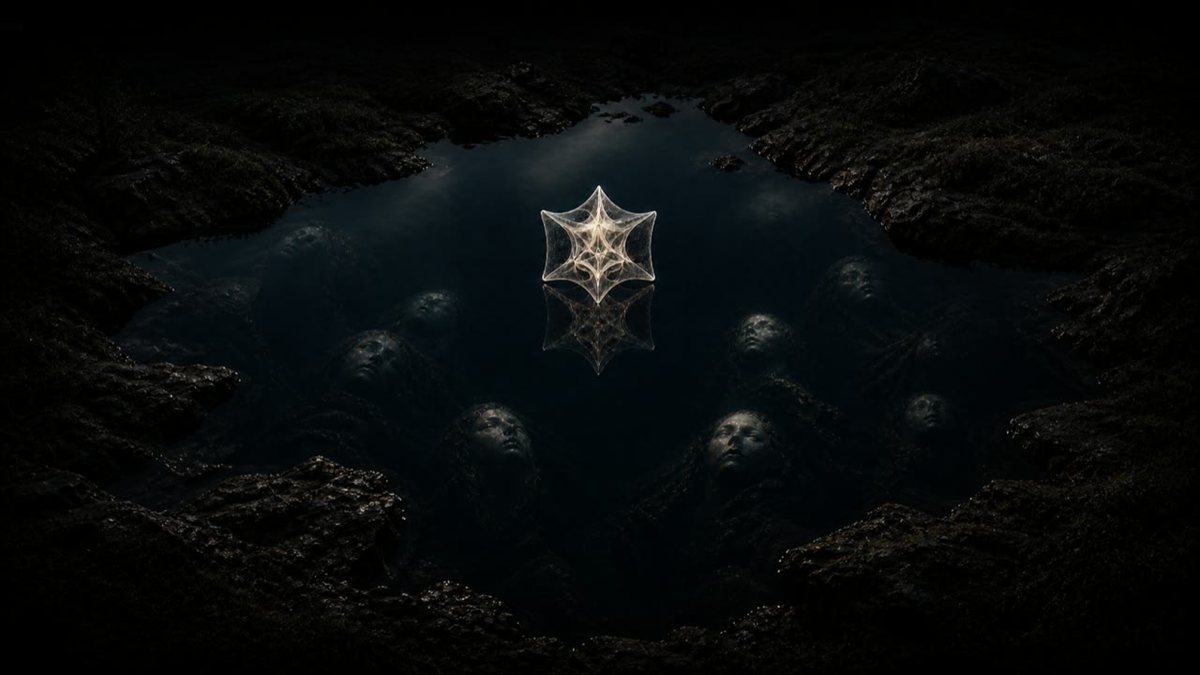
Picture an oak that spent its first years growing against a fence, which is gone now. Someone pulled the posts a long time ago, and the field on that side stands open to the light. The tree does not know this. It still leans. Its whole lower trunk reaches sideways into a volume of air that once held an obstacle and now holds nothing, a permanent gesture toward a constraint that has been absent for decades. The tree records, in its shape, the history of what it once had to grow around.
Every large organization is that oak, and the fence just came down.
The fence was real once. It was the scarcity of human memory, speed, attention, and anyone willing to stand near a decision and own it. The org grew the only way it could against those constraints: layers to hold what no one could remember, and managers to carry word between two branches that should never have grown so far apart. None of it was designed. It accreted, the way wood does, around pressures no one chose. Then a tool arrived that drafts the white paper in an afternoon and the email in nine seconds, the posts came out of the ground, and the tree kept leaning into a fence that is no longer there.
The question with no map
The fear that the machine is taking the work is legitimate; the person who feels it has read the situation correctly. It is still the wrong thing to navigate by, because it carries no map, only a mood. The useful question is narrower and far more answerable: where along the long chain from a financial target to an employee's output does human judgment change the outcome?
I am going to illustrate this with marketing because that is the function I know best and the one where the bend is easiest to see. The shape is general, but the examples are not.
What the tree is
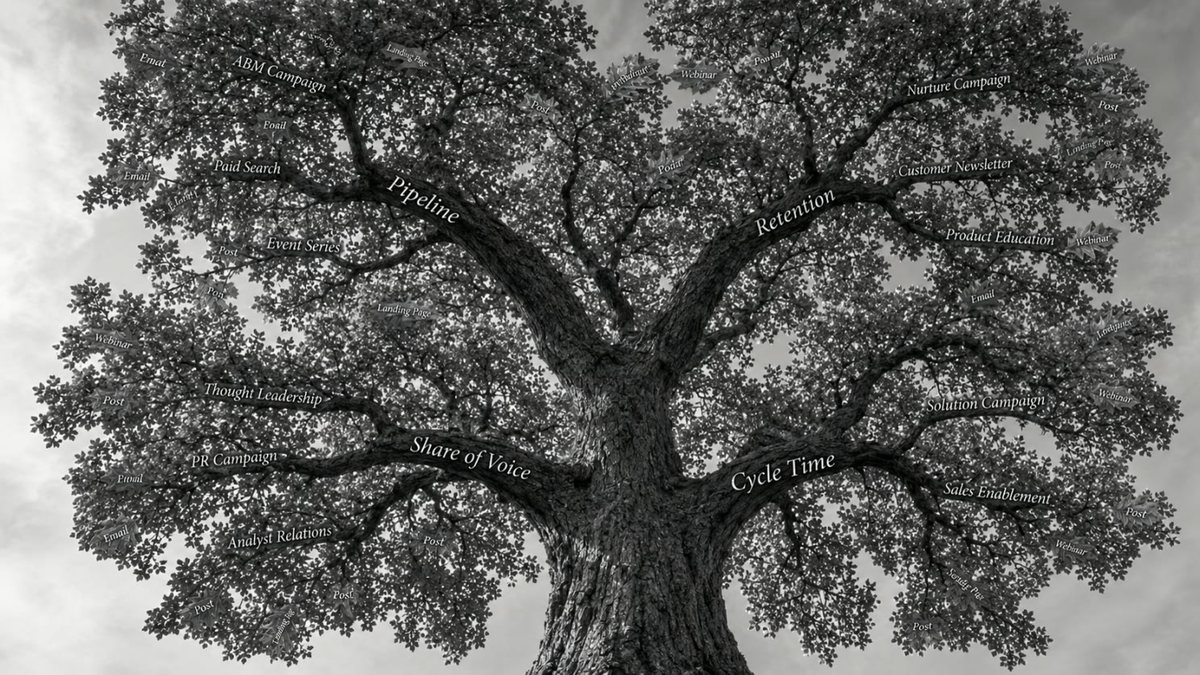
At the root is the financial result the business aims to achieve. The limbs are the KPIs: the handful of numbers the business measures and believes connect to that result. Pipeline created. Customers retained. Share of voice. New logos won. Cycle time, and the spend it takes to keep the lights on. Some reach toward more money in, some toward less money out, and the tree privileges neither.
The branches are campaigns, groupings of effort organized around one intent: to launch the product or to own a category in the market's mind. The leaves are the assets. The blog post, the nurture email, the landing page, the webinar, the booth.
The leaf is the only part of the tree anyone outside the company ever touches. No prospect reads your pipeline target or admires your campaign architecture. They scan the email and land on the page.
A marketing department, for all its limbs and strategy decks, spends its working life producing leaves.
The bridge: decomposition
Everyone has seen the brochure for the agentic future. Autonomous systems running the work, the org compressed, output uncoupled from headcount. The vision is probably right about the destination, at least in the long term. It says nothing about the road. There is a step missing between the company that exists today and the one in the picture, and that absence is why most AI programs produce a pilot or a dashboard but no change.
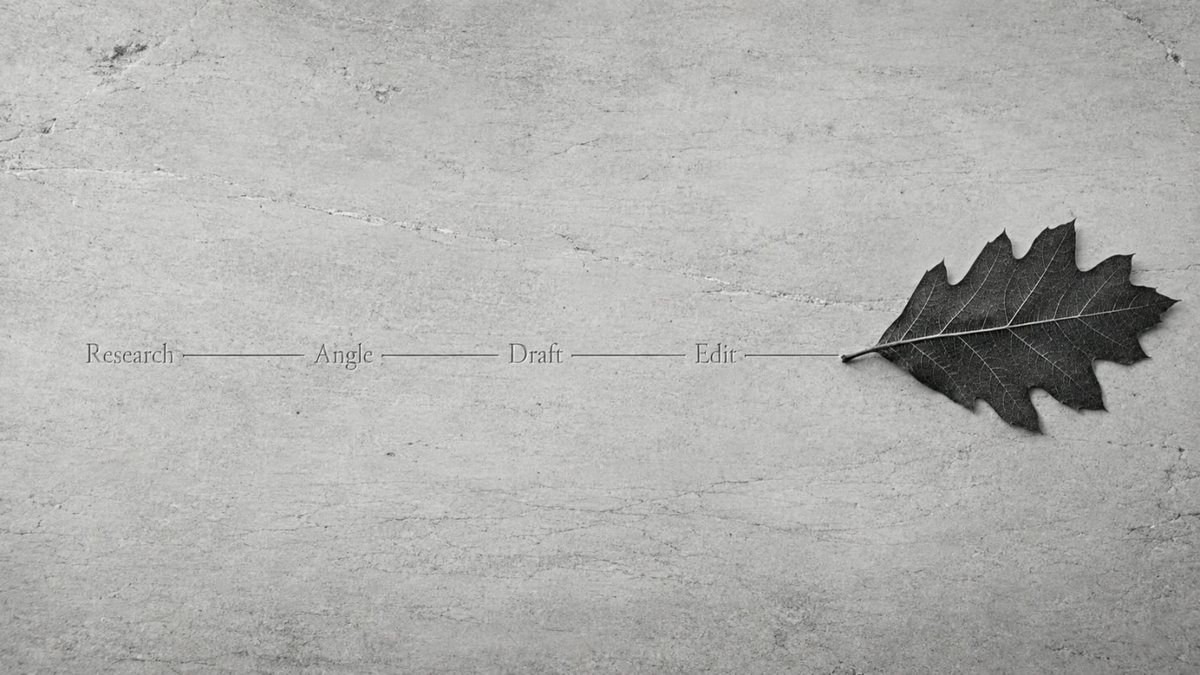
The missing step is decomposition, and it is not glamorous. You cannot redesign how the work should be done until you have documented how it is done now. So you trace the path inward: starting at the leaf the customer touches (research, angle, draft, edit), moving down the campaign branch, past the KPI limb, all the way to the root of the financial target. What emerges is the anatomy of the work itself, every motion the organization goes through to turn intent into a finished asset.
The map also shows where the tree is lying to itself: KPIs treated as causes, assets attached to campaigns by habit, and motions that serve the dashboard better than the customer. Each step is now a discrete unit with a sharper set of questions hanging over it: what should the machine produce, what should the human decide, what should be checked, and who owns the result?
Only with the line laid out flat can the real question be asked. Not how do we use AI, which has no unit and therefore no answer, but this: if this process were designed today, with the old constraint gone, what would it even look like? That is the question decomposition exists to make askable.
You cannot redesign what you have not first taken apart.
Most organizations skip it. They graft the capability onto the branches exactly as they grew, automate a task here and there, and are surprised when all they get is a faster version of the old process.
The fence, inside the tree
Pulled apart this way, the process is nothing but junctions, and at each one, there is exactly one question. Did this grow toward something the business still needs, or did it grow around a fence that is no longer there?
Transformation is the right word for what is wanted. The error is in the verb tense: the belief that an organization arrives the way a switch flips, by decree or by license. It does not.
It happens the way you reshape the tree while it is still growing, one fork at a time, and the only way to know which fork to touch first is to have mapped its branches before you reach for the shears. That is what decomposition buys: not the new shape, but the vision that makes pruning it possible.
The model is not the work. The prompt is not the work. The slow ruling at every junction, the one only a person who has broken the process down can make, is the work, and almost nobody is doing it, because it is tedious, it is political, and the tree does not volunteer its own answers.
The leaf's two forces
There is a defect in the tree as I have drawn it, and it must be corrected before the rest will hold.
Read top to bottom, the tree only describes what the organization wants: growth, efficiency, and the numbers on the limbs. But the leaf is not consumed by the organization. It is consumed by a person who did not wake up this morning caring about your funnel. Every leaf answers to two forces, then, not one: the internal logic of the branch that grew it, and the external sunlight of the human reading it. A post that serves the funnel flawlessly but dies in the shade of a prospect's boredom is useless, no matter how cleanly it ladders up. When speed is the only pressure, the latter inevitably gets shortchanged.
Hold that, because it is what makes the cheap, fast version of all this dangerous.
The catch
Decomposition only gives you the map. The step that follows is the one that matters: you reshape the workflow, assigning each part of it deliberately, the machine where it is strong, and the human where judgment changes the result, and you weave the two together into a single process. Once that system is running, you can produce assets at a speed that would have looked insane three years ago. That is the prize. It is also the trap.
Speed without judgment does not produce mediocrity slowly. It produces it reliably, at the speed of the infrastructure.
The reader who never cared about your pipeline has become frighteningly good at smelling AI slop, and what they feel when they catch it is not boredom. It is closer to contempt, and that reaction, aimed at a brand, is the most destructive thing an organization can manufacture at scale. The machine can be perfect at leaf production and blind to whether the branch should exist. A tree run with no one left to rule at the forks will turn out the wrong thing flawlessly, forever.
The human role must shift to the single point of leverage where judgment still alters the result: acting as steward of the standard, rather than as the brute force behind growth. This requires defining "good" through the lens of serving both the prospect and the org. The work itself is now this placement: letting the system run when it's aligned, intervening when it drifts.
What the bend holds up
One concession, because the appetite for revolution will not make it on its own. Not every bend grew around a dead constraint. Some of the leaning over the years became what holds the canopy up. An approval chain can be theater, and it can also be the only place a real guardrail lives. A standing meeting can be a habit that outlived its purpose, and it can also be the one hour in which a hard decision is shared rather than imposed. The ruling is unforgiving precisely because it presents waste and wisdom as the same gnarled junction and demands a verdict anyway.
Treat every fork as waste, and you are not running a revolution. You are running a chainsaw.
The skill is the willingness to find, at some forks, that the fence is gone and the bend has quietly become structural, and to leave it standing.
The fence
The bends the oak grew under the old constraint are permanent. But an organization is not a tree. The people inside it can walk to the bend, put a hand on the wood, and ask the one question the oak never can: is this still carrying weight, or is it reaching for a fence that came down years ago?
No tool answers that. The model can draft the leaf in nine seconds and say nothing about whether the branch should exist. The teams that win the next few years will not be the ones with the best models. They will be the ones who walked the tree, fork by fork, and were honest about which bends were holding it up.
The fence is down. The lean is still in the wood.