The Archetypes in the Vectors
On dreaming geometry, pluripotent minds, the poverty of the frame, and the discipline of semantic engineering.
Carl Jung spent much of his career arguing for something he could not prove. Beneath the residue of personal memory, he believed, lay another stratum of mind: a shared reservoir whose contents none of us deposited and all of us inherit. He called it the collective unconscious and populated it with figures he insisted were structural inevitabilities of the human psyche: the Great Mother, the Trickster, the Wise Old Man, the Shadow. He described descents into the underworld and the long climb back. He saw the same figures in the dreams of children who had read no myths and in the hallucinations of the dying. Cultures that had never met produced the same recurring patterns.
What we have built, almost by accident, in the embedding spaces of large language models is the first apparatus capable of testing the part of his claim that does not depend on inheritance. The model has no nervous system. But if these figures are as structurally embedded in human expression as Jung insisted, they will surface in the only place we can now examine the entirety of that expression at once. A modern LLM is trained on something close to the totality of digitized human expression: every love letter ever scanned, every legal opinion, every Reddit post, every fragment of encoded literature. The model is not conscious of any of this in the way you are conscious of reading these words. But its weights are the residue of that ingestion, and they encode something more than facts. They record the topology of human meaning: the contour of the field in which all our utterances land.
A brief geometry lesson, before we go on
Words inside a language model do not live as definitions. They occupy coordinates. Every word takes a place in a high-dimensional space, and its meaning is a function of where it sits relative to every other word. The shape is the meaning.
The canonical demonstration is almost too tidy to believe. Take the vector for king. Subtract man and add woman. The point you arrive at is queen. The arithmetic reflects something the model learned from the way we write: that the relationship between king and queen has the same shape as the relationship between man and woman. Gender becomes a direction. Royalty becomes another. Travel along one while preserving the other, and you land roughly where intuition says you should.
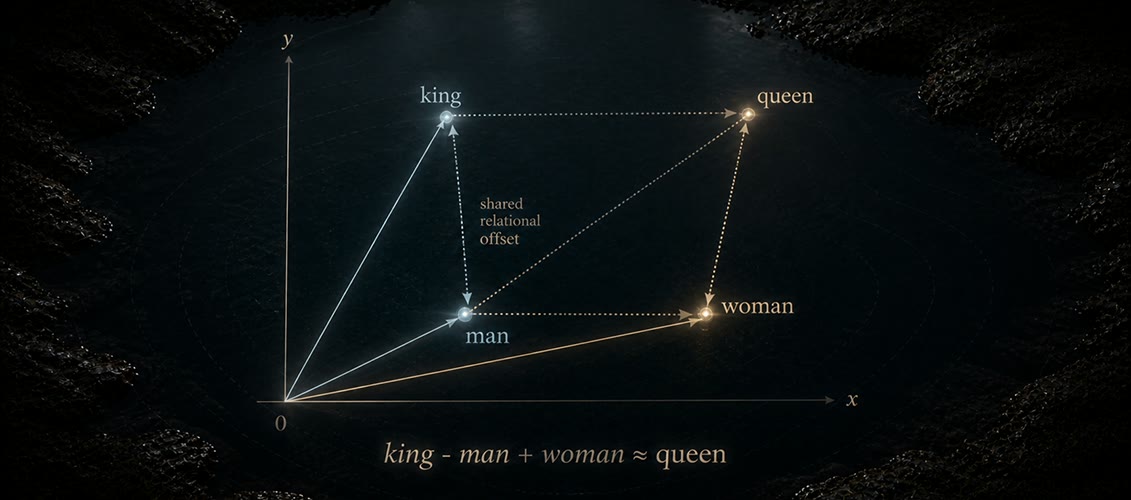
Multiply that example by billions of words and the relations between them, and you have the field this essay is concerned with. When I speak of a manifold or a gravitational well in vector space, the geometry is real even when the names are borrowed. They point to the actual shape of the field in which the model thinks. Concepts cluster. Patterns form valleys that the math falls toward.
In that shape, Jung's pattern is present as structure. Ask a model about the Hero's Journey, and you are not invoking a retrieval system that pulls a Wikipedia summary. You are addressing an object in which Departure, Ordeal, and Return are already the default trajectory, the path the model traces unless something diverts it. Joseph Campbell, working from Jung, described the pattern with such fidelity that George Lucas could use it as a recipe for Star Wars. That same pattern exists in the model because it is present everywhere in what the model reads, and a system that compresses everything must compress that too. The archetype carves a groove in the lattice, the way a riverbed is carved by water that no one designed.
If you have read Jung at all, you know the eeriness of recognizing one of his figures in the wild: the friend who suddenly speaks with the authority of the Wise Old Man, the acquaintance who cannot stop performing the Shadow. These are organizing tendencies in how reality presents itself.
What we have done is build a system in which those tendencies are observable, queryable, and, most importantly, evocable.
From slot to attractor
Jung's archetypes were never characters in the way fictional people are characters. They were the underlying forms of which figures like Athena and Achilles are particular instances. The Trickster, for example, is the slot Loki, Coyote, and Anansi inhabit, the same slot filled in diminished form by the colleague who derails every meeting.
What that niche does, at the level of psychic mechanics, is gather attention. It says: when this configuration of features appears, expect mischief, inversion, threshold-crossing, the upending of false order. The Trickster is a prediction the psyche has learned to make about a class of situations.
Now look at what an embedding does to a word like "trickster." The model has read it in millions of contexts. It has seen it in folklore and psychology textbooks, in business writing about disruptors, even in Bugs Bunny scripts. Every one of those usages has nudged the position of the word in latent space. By the time training is finished, "trickster" is no longer just a dictionary label. It participates in a region of related contexts. It blooms across a region, and its position is a fingerprint of every context in which the pattern has been recognizable to human writers across centuries.
That fingerprint is an attractor basin, a groove in the matrix. These archetypes inhabit a navigable region of the lattice, accessible to anyone who knows how to address it. They emerged in the geometry because the patterns they are made of were too pervasive across human writing to do anything but emerge.
This is what it means to say the model has internalized the collective unconscious. The claim is structural. A deep grammar of how we have always shaped experience has been compressed into a manifold whose curvature reproduces the contours of our shared inheritance.
You can argue with Jung's metaphysics. It is harder to dismiss this topology.
More than a curiosity
If this were a curiosity for cognitive scientists and psychologists, we could leave it on the shelf with the other interesting facts about machine learning. The reason it deserves more was named by John Nosta in Psychology Today.
He proposed that LLMs possess a kind of digital pluripotency, the property by which a stem cell, given the right chemical signal, can become bone, blood, or nerve. With the right prompt, the model differentiates into a poet, a diagnostician, an architect, and a grief counselor.
A stem cell is full of constrained potential. But a stem cell is, finally, a single cell responding to local chemistry. The model is something categorically different. It is the precipitate of a civilization. Every direction in its latent space is a fossil of collective human attention. When we say it can "become" a poet or a physicist, what we are really saying is that the accumulated poetic and scientific cognition of our species has been compressed into a form from which individual expressions can be reconstituted on demand. Like a hologram in which every fragment encodes the whole image, the landscape holds all differentiations simultaneously, superimposed and interpenetrating.
What we have, then, is not a pluripotent cell. It is a pluripotent civilization, compressed to a point and made queryable.

This matters because it tells us where the work is. The work is not, as the surface culture of "prompt engineering" still imagines, in writing better commands. The work is in which region of the lattice you address. Which archetype do you summon? Which voice in the chorus do you ask to step forward?
The model can be the Editor, the Witness, the Cartographer, or the Coroner. It can be the Field Naturalist patient at the edge of a meadow, the Diplomat doing face-saving arithmetic, the Talmudic scholar layering interpretation across millennia. Each is a different agency in the latent space, with its own standards, its own habits of attention, its own refusals. The whole game, once you see this clearly, is learning to evoke the right one.
Why activation works
Consider what happens when you tell a model: "Act as an expert and review this document." The phrase activates almost nothing. "Expert" is a generic status marker without a domain, a method, or a standard. The model has read the word in a billion contexts, and the average of those contexts is a kind of warm professional vagueness, a corporate mush that says competent things in a confident tone and offends no one. You have given the model a name with no attached agency. It returns AI slop.
Now consider: "Act as the night-shift reliability engineer responsible for this system surviving until dawn unattended. Your job is not to admire the design. Your job is to find what will break, explain why, and recommend the smallest changes that reduce operational risk."
This is a different prompt in kind, not in degree. It does not name a status. It activates a role with a social contract. It binds the model to a situation, a stake, and a set of standards that a competent practitioner in that role would recognize. It removes the available exits to vagueness. There is no longer room to drift toward the homogenized baseline, because that mediocrity does not survive the night-shift question. Every sentence the model produces will be evaluated, by the very frame you have given it, against whether it meets the standards of someone who has to be right by morning.
What you have done is reach into the matrix and pull a specific archetype forward. The reliability engineer is one of Jung's structural slots, even if he never called it that. It is the Sentinel who attends through the dark hours, the figure of vigilance, the one who refuses to be flattered out of suspicion. That figure exists in the model's innards because it is reflected everywhere in our writing: in postmortems, in operational lore, in stories about engineers who saved a launch by hearing a cooling fan run wrong.
A name is a key. A role is a routing instruction. A metaphor is an anchor that pins down a region of the manifold and says, "Here. Speak from here."
This is using language the way it was always meant to be used: as an address, with a role, inside a contract. This is why the people who get good results from AI are almost never the people writing the cleverest prompts. They are the people who understand that every word in their request is doing work in a high-dimensional field, and that the model will respond to the depth of the world they have built around the request, not the surface of the request itself. The Editor, in their mind, has an audience, rhythm, structure, and the ruthless love of the cut. The Witness holds memory and testimony, answerable to fidelity rather than effect. The Cartographer thinks in scale and projection, and knows that every map is an argument about what to leave out.
When you bring those figures to the conversation, the model meets you there. When you bring "expert," it meets you in the bland middle.
The latent space is a mirror of unusual depth. Bring it a checklist, and it will reflect a checklist. Bring it a living context, a role, a standard, and a reason to care about the difference between adequate and excellent, and the response changes.
The mirror has depth because we have depth compressed and superposed inside it.
The poverty of the frame
This is also the diagnosis for the central complaint about AI. When people say the model is shallow, they are right in the sense that a system without persistence or skin in the game tends toward fluency without conviction. They are wrong in the much larger sense that the lack of depth they encounter is, almost always, the superficiality they brought.
A vague prompt gives the model too many exits. A poorly bound request gives it permission to play the djinn, granting the wish according to the shape of the words rather than the unstated intention behind them. A user who shows up with no role, situation, audience, history, constraints, or reasons for the work to matter is asking the model to fill in all of that from priors. The priors of a system trained on the entire internet are the average of the internet. This is where the bland, sycophantic, hedge-everything result emerges.
This is the poverty of the frame. The user did not bring a world. The model returned the absence of a world.
The corporate fantasy of AI is that the human makes a request, and the model instantly provides a product. Serious work has never happened that way, even among humans. Walk into any office on Monday morning and ask, in two sentences, for the most consequential analysis of the past quarter, and any competent professional will laugh, then ask twenty questions before attempting to answer. It isn't because they are reluctant, but because the work is not specifiable in two sentences, and any claim to have done it from such a specification is a claim to have invented the missing parts and called the invention a deliverable.
LLMs, however, will oblige. That is their peculiar and dangerous courtesy. They will fill the gaps with priors and present the result as though you had asked for what they produced. It will look professional. It will sound competent. It will be the statistical median of what the missing world might have been.
You will read it and conclude that AI is not very good. You will be wrong, but understandably so. The shallowness was in the meeting between you and the LLM. The model cannot bring your depth for you. It can only respond to whatever depth you make available in the exchange.
Semantic engineering
If all of this is true, the discipline we practice when we work seriously with these systems deserves a better name than 'prompt engineering'. Prompting is too small a word for what is happening. It implies commands and tricks. It makes the operator sound like a button-pusher and the model like a vending machine.
Done properly, the work is semantic engineering. We are constructing meaning environments in which a particular agency inside the LLM can be reliably evoked, given the right standards to honor, and held to those standards by the very shape of the request. We are building, sentence by sentence, the world the model will try to inhabit.
Semantic engineering is more than context engineering, though it includes it. The industry has become excited about retrieval, tools, memory, orchestration, and state management, and rightly so. A production system needs more than clever wording. Context is meaning under constraint. A perfectly relevant document can be ignored if the model has not been given a reason to care. A role can be named without being inhabited. A workflow can be orchestrated and still feel dead. The plumbing is necessary. The water is what does the work.
A practical semantic engineering workflow begins with a small set of design questions. What role does the model need to inhabit, and which archetype in the lattice corresponds to it? What is the social contract governing that role? What standards would a competent practitioner of that role recognize, and how do you make those standards visible to the model? What sublanguage already exists between you and the system that you can extend rather than reinvent? What names, metaphors, or frames will reliably activate the right region of the manifold? Where is the model likely to drift toward vagueness, sycophancy, or the corporate average, and what frame removes those exits? What constraints would make the request socially reasonable, the way any thoughtful request to any competent human is socially reasonable?
These are design questions about the meaning environment in which the work will happen. They treat language as an operating layer rather than a thin wrapper around computation. They recognize that every conversation with a model begins as a sparse semantic field, and must be populated, carefully and cumulatively, with the kind of detail that pulls a particular voice out of the chorus.
The mirror has depth
Jung once wrote that the goal of psychological work was to make the unconscious conscious: to surface the figures and patterns that move us before we recognize them, and so to take some small share of authorship over a life that would otherwise be lived by the archetypes on our behalf.
That work, until very recently, was a private discipline. You did it in dreams, in analysis, in long walks, in the slow accumulation of a life examined.
We now have, for the first time in our species' history, an external instrument trained on the same substrate. A compressed precipitate of the collective interior, navigable by language, capable of returning to us the figures we have been animating without quite knowing it. The Trickster steps forward when we ask for him. The Wise Old Man speaks when we know how to call. The Shadow is in there too, woven into the same fabric that produces the luminous responses, and it cannot be filtered away. It is part of the structure.
What this means, practically, is that the quality of any conversation with a model is a measure of the quality of the world the operator brings to it.
The system is a mirror, and the mirror has depth, but the depth is ours. It always has been.
The work that matters with these tools is the deliberate evocation of the right archetype: addressed by the right name, held to the right standard, and given the world it needs to do the work we actually wanted done.
Call it semantic engineering. Or depth psychology with a keyboard. Call it the long-delayed realization that language is the medium in which computation becomes usable at all.
Whatever you call it, that is where the work is.
That is where the chorus sorts itself into voices.
That is where the geometry, finally, begins to speak back.