Sage in the Machine: Reifying Wisdom for the AI Age
On turning a great thinker’s method into something you can question, not just read.

THE POCKET ARISTOTLE PROPHECY
What if you could ask Plato about your existential crisis? Or have Einstein evaluate your physics theory?
In 1983, a young visionary stood before an audience at the International Design Conference and shared a dream that would take forty years to realize. Steve Jobs lamented that while he could read the works of Aristotle and Plato, he could never ask them questions. He envisioned a future machine that might capture a person's "underlying spirit, or underlying set of principles, or underlying way of looking at the world" – a technology that could respond to inquiries as the original thinker might have.
Jobs, who famously said he would trade all his technology for an afternoon with Socrates, understood something profound: true wisdom isn't just about information delivery – it's about accessing the living, breathing methodology of great minds.
Today, that vision isn't science fiction. It's a deployment option.
I. FROM CAMPFIRE TO CODING: THE EVOLUTION OF KNOWLEDGE
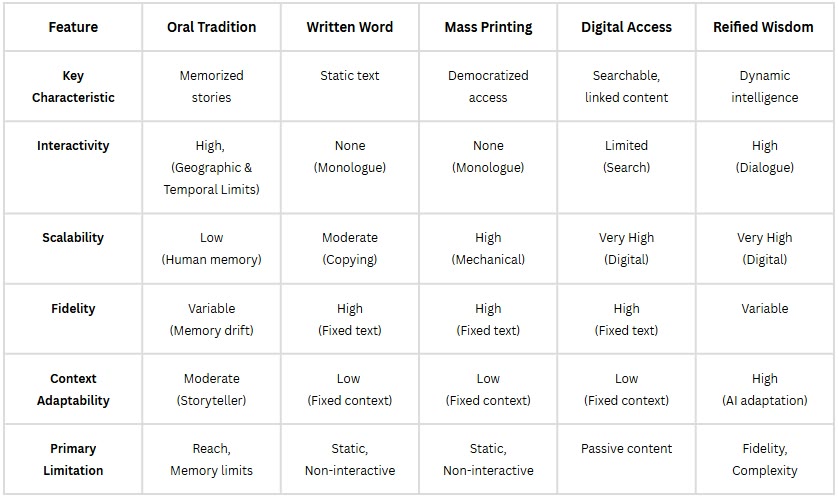
Throughout human history, we've developed increasingly sophisticated methods to preserve and transmit wisdom:
The Oral Tradition: Knowledge passed through memorized stories, limited by human memory and geographical reach.
The Written Word: Revolutionary but fundamentally static – frozen at the moment of writing.
Mass Printing: Democratized access but maintained the one-way nature of knowledge transmission.
Digital Access: Made content searchable and linked but maintained its fundamentally passive nature.
And now we arrive at the fifth great revolution in knowledge: Reified Wisdom – the transformation of expertise from documentation to dialogue, from static artifact to active intelligence.
Reify: To make (an abstract idea or concept) real or concrete
II. BREAKING THE FOURTH WALL OF KNOWLEDGE
Books have been humanity's greatest knowledge repository for millennia, but they operate behind an invisible barrier – like actors who can't hear the audience. Reified wisdom breaks this fourth wall, creating a fundamentally different relationship between thinker and reader:

Dead Letters vs. Living Thought
Books are intellectual fossils – beautiful, valuable, but unchanging. Once published, they're frozen in time. Peter Drucker, who wrote "The Effective Executive" in 1966, couldn't comment on remote work during a pandemic or the management challenges of the gig economy.
AI "living libraries" remain alive. They can be used to evaluate new circumstances through the lens of the original thinker's principles. It doesn't just tell you what Simon Sinek thought about purpose-driven organizations in 2009; it applies his framework to the purpose challenges your organization faces today.
Monologue vs. Dialogue
In Plato's Phaedrus, Socrates famously critiques writing as a lifeless or unresponsive knowledge. Written words might "stand like living beings" on the page, but if you ask them something, "they preserve a solemn silence" and "always say only one and the same thing" regardless of who asks. In other words, a book cannot clarify its meaning or adapt its explanation to the reader—it offers only the "appearance of wisdom, not true wisdom". Genuine knowledge, for Socrates, was dialectical, a living exchange in the mind. He contrasts the written word (a "bastard" sibling) with the "living and breathing word" that genuinely knows its audience and can defend itself in dialogue.
AI transforms this monologue into a dialogue. Imagine reading Seth Godin's insights on permission marketing and being able to immediately ask, "How would this approach work for my SaaS product?" The reified Seth doesn't need to have explicitly written about that particular case – the AI can apply his methodology to new contexts.
Linear Journey vs. Choose Your Own Adventure
Traditional texts force every reader down the same path in the same sequence. Every reader of "Good to Great" walks through Jim Collins' research in precisely the order he arranged it, whether that sequence serves their unique learning style or immediate needs.
Wisdom encoded digitally lets you chart your own course – starting with what matters to you most, skipping what you already understand, and diving deeper into areas of personal relevance. The journey becomes yours, not the author's.
Relational Knowledge vs. Static Content
The written word contains what an author consciously chooses to include. But the most valuable aspect of great thinkers isn't just what they concluded – it's how they approached problems, the connections they made between seemingly unrelated concepts, and the methodologies they developed.
Machines can now capture these patterns between ideas – the implicit connections, the problem-solving approaches, the conceptual frameworks that form the true essence of a thinker's contribution.
Comparison of Knowledge Transmission Methods
III. REIFICATION IN ACTION
Is It Punchy?
Emma Stratton's "Make it Punchy" book has been encoded into an AI that evaluates B2B messaging against a custom rubric, providing not just scores but actionable feedback on how to sharpen your communication. It's like having a world-class messaging consultant review your work in real-time, pointing out where your value proposition lacks clarity or your call-to-action needs strengthening.
Golden Circle Guide
Simon Sinek's "Start with Why" methodology has been transformed into an interactive guide that uses Socratic dialogue to help organizations discover their true purpose. Rather than just explaining the Golden Circle concept, this AI leads you through a personalized discovery process, challenging your assumptions and helping you articulate a purpose that's authentic to your specific needs.
What Would Godin Do?
Seth Godin's marketing principles have been distilled into an AI mentor that can apply his distinctive approach to your specific challenges. When faced with a marketing dilemma, it doesn't just quote from Purple Cow or Permission Marketing – it considers what Seth might advise in your particular situation, based on the patterns of his thinking across decades of work.
Next Steps
While the examples above are useful, they are only a starting point. Imagine consulting a council of AI sages before moving forward with your next big project or converting these or ones like them into autonomous agents operating within defined workflows. This is already possible today.
IV. THE BUSINESS IMPERATIVE: WHY THIS MATTERS NOW
For modern leaders, knowledge crystallized in AI isn't just intellectually fascinating – it's a competitive necessity. Here's why:
Expertise Scaling Crisis
Organizations face an unprecedented expertise bottleneck. Markets evolve faster than we can hire experts or upskill existing talent through traditional methods. AI-distilled wisdom allows you to scale expertise exponentially – giving everyone from junior contributors to senior strategists access to world-class thinking tailored to their specific challenges.
Decision Velocity as Competitive Advantage
In today's markets, decision speed often trumps decision perfection. Companies that can rapidly apply high-quality strategic thinking to emerging challenges outperform those stuck in analysis paralysis. Reified wisdom compresses what might have been weeks of research, consultation, and deliberation into minutes or hours.
The Personalization Paradox
The market demands increasingly personalized customer experiences, yet the complexity of delivering those experiences has outpaced traditional approaches. AI helps resolve this paradox by providing hyper-contextual guidance – essentially personalizing the expertise itself to your specific customer scenarios.
V. BEYOND INFORMATION: A COGNITIVE TRANSFORMATION
What makes AI-sourced "legacy echoes" revolutionary isn't just its accessibility but its cognitive nature. This isn't about better information retrieval – it's about fundamentally different modes of knowledge transfer:
From Explanation to Illumination
Books explain concepts. Reified wisdom illuminates paths forward. Rather than simply describing what worked for others, it reveals what could work for you specifically, lighting up previously unseen possibilities.
From Reference to Reasoning Partner
Books serve as references – static repositories to be consulted. Reified wisdom functions as a reasoning partner, actively engaging with your thinking to refine strategies, identify blind spots, and strengthen arguments.
From Answer Provider to Question Improver
Perhaps most valuable, knowledge encoded in AI doesn't just answer your questions—if appropriately implemented, it helps you ask better ones. It identifies the unstated assumptions in your inquiries, surfaces relevant factors you hadn't considered, and guides you toward more productive lines of investigation.
VI. THE HUMAN IN THE LOOP: ETHICAL DIMENSIONS
The reification of wisdom raises profound questions about authenticity, accuracy, and the relationship between human and artificial intelligence:
Fidelity vs. Fiction
How do we ensure that AI distilled wisdom represents the original thinker's approach rather than a simplified caricature? This requires both technological rigor and philosophical clarity about what constitutes authentic representation.
Augmentation vs. Replacement
AI won't fully replace human experts but extend their reach and impact. The most potent implementations pair human judgment with reified intelligence, creating combinations that exceed what either could achieve alone.
Evolution vs. Stagnation
Should reified wisdom remain fixed as a perfect representation of its source, or should it evolve as it encounters new contexts? Perhaps the most elegant approach is one that clearly distinguishes between the thinker's documented positions and reasonable extensions of their methodology to novel circumstances.
VII. BEYOND THE HYPE: CURRENT LIMITATIONS
Let's be clear: speaking with a digital twin isn't the same as conversing with the original mind. However, this perspective misses a crucial point: we should judge these tools by their utility, not their consciousness.
The essential question isn't whether machine sentience has been achieved or if the digital twin perfectly matches its human inspiration. Instead, we should ask: Are the outputs genuinely useful? Even skeptics acknowledge that current implementations deliver practical benefits when properly deployed.
This pragmatic approach reveals that reified wisdom already offers tangible value while maintaining a clear-eyed view of its limitations.
VIII. FROM INDIVIDUAL TO COLLECTIVE WISDOM: THE FUTURE
The most profound potential of reification extends beyond individual thought leaders to entire intellectual traditions:
School Reification
Moving beyond individual thinkers to capture entire schools of thought – the Chicago School of Economics, the Bauhaus design principles, the Toyota Production System – making comprehensive methodologies accessible and adaptable.
Organizational Wisdom Preservation
Capturing the tacit knowledge of retiring experts, ensuring that decades of organizational learning aren't lost with personnel changes.
Wisdom Synthesis
Creating new insights by facilitating dialogue between reified thinkers from different eras and disciplines – allowing Einstein to comment on quantum computing or Jane Jacobs to address contemporary smart city design. There's no reason to limit ourselves to single minds either – some of humanity's greatest breakthroughs have come from the fusion of previously separate traditions (think of Zen emerging from the synthesis of Daoism and Buddhism or Reggaeton evolving out of the intersection of Dancehall + Latin American rhythms + hip-hop).
CONCLUSION: THE WISDOM RENAISSANCE
Four decades ago, Steve Jobs imagined a future where we could converse with history's great minds. Today, that future has arrived – not just as a technological curiosity, but as perhaps the most profound transformation in how humanity accesses wisdom since Gutenberg's press.
The reification of wisdom doesn't replace books any more than books replaced oral tradition. Rather, it adds a new, dynamic dimension to our intellectual heritage—one that promises to make humanity's accumulated wisdom more accessible, more applicable, and more alive than ever before.
As leaders in the digital age, you stand at the vanguard of this transformation. The question isn't whether reified wisdom will transform how organizations access expertise – it's who will lead that transformation and reap its unprecedented benefits.
The pocket Aristotle is no longer a distant dream. It awaits your questions right now.