PILOT: Your Navigation System for AI’s Jagged Frontier
A field guide to thriving in the era where machines write symphonies but can’t count the instruments.

A field guide to thriving in the era where machines write symphonies but can't count the instruments.
The $4.4 Trillion Paradox
Picture this: A Fortune 500 CEO sits at her desk, reviewing two AI-generated reports. The first one? Brilliant. A five-year market analysis so innovative her board called it "transformative." The second? A simple revenue projection that's off by millions. Why? The AI got confused between fiscal years and calendar years.
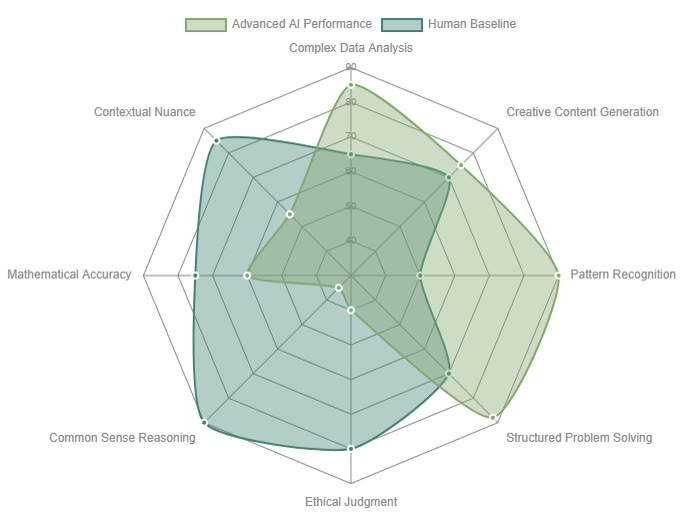
This pattern repeats everywhere. In radiology, AI systems detect cancer patterns invisible to human eyes - then flag shadows as tumors. Architecture firms watch AI design revolutionary building facades that look incredible but can't calculate if the windows will open. A hedge fund's AI spots market patterns worth millions, then loses it all on basic arithmetic.
McKinsey dropped this stat recently: "While nearly all companies are investing in AI, only one percent of leaders call their companies 'mature' on the deployment spectrum." They're talking about a $4.4 trillion opportunity here. But (and it's a big but) 92% of companies are throwing money at AI without really knowing where it works and where it faceplants.
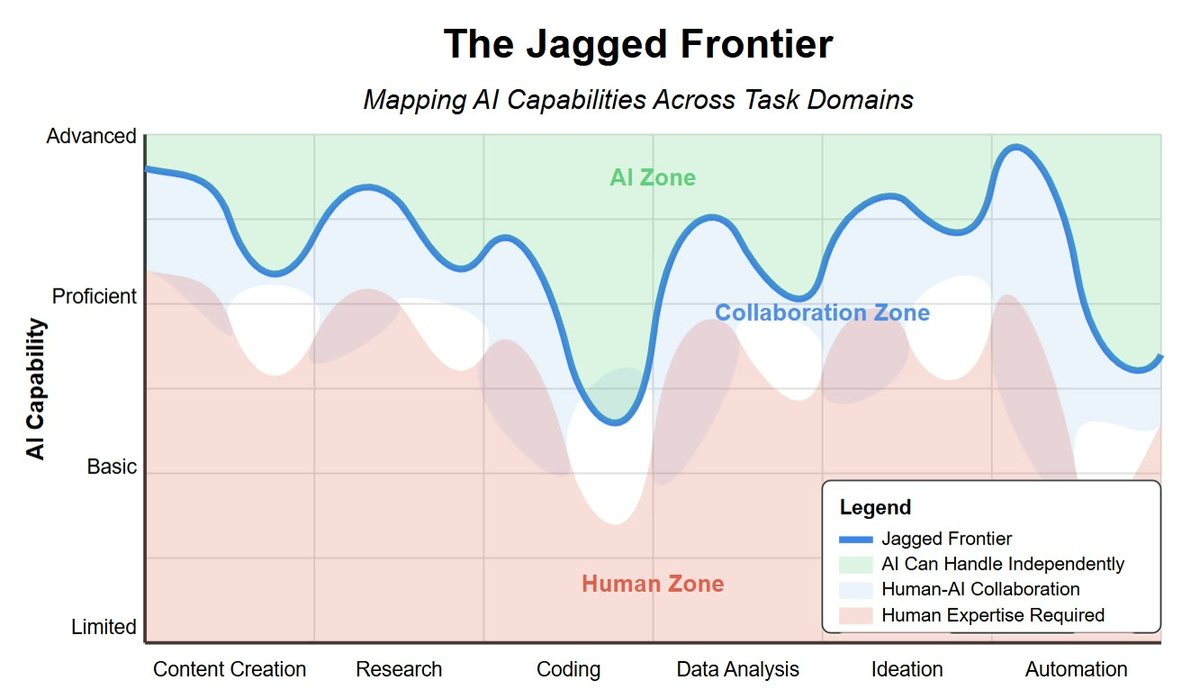
Welcome to what Ethan Mollick calls the Jagged Frontier. It's 2025, and we're all trying to dance along an edge we can barely see.
Jagged Frontier (n.): That unpredictable line between tasks where AI excels and where it totally bombs. Think of it as the world's most expensive game of "will it work?"
The Frontier Evolves
Two years after the groundbreaking BCG experiment revealed AI's "jagged" capabilities, the frontier has shifted dramatically. That 2023 study tested 758 consultants with GPT-4 on real business tasks. The results were wild - consultants using AI crushed it on some tasks (12.2% more tasks done, 25.1% faster, 40% better quality). But here's the kicker: when the task fell outside AI's sweet spot, those same consultants did WORSE than people working without AI.
Fast forward to now. Microsoft's calling 2025 "the year the Frontier Firm was born." Companies aren't just playing with AI anymore; they're rebuilding entire businesses around it.
But nobody wants to admit this: the frontier hasn't gotten smoother. If anything, it's MORE jagged now, which makes the cognitive migration that is underway even more challenging.
Professor Hila Lifshitz-Assaf (she was part of that original BCG study) put it perfectly: "Even if you manage to accurately map the jagged frontier of AI's abilities today, the technology is evolving so fast that the boundary line may well shift tomorrow."
We see proof everywhere. Law firms are finding AI can draft incredibly complex contracts but then it screws up calculating basic statute of limitations. Marketing teams watch AI create viral campaign concepts while bungling brand alignment. One legal tech analyst said it best: "These models might generate highly competent results in complex, creative tasks but fail at simple arithmetic or basic logic." In legal work? That's not just annoying. It's dangerous.
The Rise of Frontier Firms
Microsoft's research shows 82% of leaders believe this is the year to rethink completely how they operate. Makes sense, right? Except... 53% say they need more productivity while 80% of workers are already burned out.
This is the Capacity Gap—the growing chasm between what businesses need and what humans can deliver. And it's forcing a fundamental reimagining of work itself.
This is where Frontier Firms come in. These companies aren't just using AI as a fancy autocomplete. They've accepted that AI is permanently unpredictable and built their entire operation around that reality.
What's different about them? They've given up on the fantasy that AI will smoothly upgrade human work. Instead, they've built systems that work WITH the jaggedness.
Centaurs, Cyborgs, and Your New Coworkers
Those BCG consultants from the original study? The successful ones evolved into two types of workers that are becoming actual job categories now.
Centaur (n.): Someone who keeps human work and AI work totally separate. Like the mythical creature - clear line between the human half and horse half.
Centaurs draw hard boundaries. A financial analyst might use AI to crunch massive datasets and spot patterns. But client presentations? Strategic recommendations? That's all her. Clean split: AI handles data, human handles judgment.
Cyborg (n.): Someone who blends so deeply with AI that you can't tell where human ends and machine begins.
Cyborgs? They're a whole different breed. Watch a modern content creator work - they'll start writing a headline, let AI suggest endings, tweak what the AI wrote, ask for variations, grab pieces from each version, then go back-and-forth refining. One marketer described it as "having a conversation with a really smart colleague who never gets tired."
What's changed since 2023 is these aren't just personal work styles anymore. They're becoming actual job titles. Microsoft reports that "24% of leaders say their companies have already deployed AI organization-wide," and with that deployment comes new organizational structures built around human-AI collaboration patterns.
The Traps Nobody Talks About
Lifshitz-Assaf dropped this bombshell about their study: "Another major risk that became evident during our study was the decrease of cognitive diversity." Basically, when everyone uses AI, everyone's work starts looking the same.
That's just one trap. Here are the others keeping folks up at night:
The Confidence Trap: AI outputs look SO professional. They sound smart even when they're dead wrong. One researcher called LLMs "fundamentally opaque" - sometimes they produce garbage that looks like gold.
The Skill Atrophy Problem: Use AI for everything routine, and humans forget how to do the basics. The BCG study found consultants got lazy with AI around, performing worse on judgment calls.
The Moving Target Mess: PitchBook's 2025 report mentions "high compute costs, data availability, data security, and overall system complexity." Translation: what worked yesterday might break today when the model updates.
Quick Reality Check: Where's YOUR Frontier?
Based on what Harvard, MIT, Wharton and a bunch of companies have learned the hard way:
AI Usually Rocks At:
- Finding patterns in huge piles of data
- Writing first drafts of basically anything
- Generating and debugging code
- Analyzing structured data
- Brainstorming (quantity over quality)
The Danger Zone (Handle with Care):
- Anything needing exact calculations
- Tasks requiring actual common sense
- Work with ethical implications
- Problems needing understanding of how the real world works
- Tasks where mistakes really, really matter
Keep Humans in Charge:
- Big strategic decisions
- Building actual relationships
- Complex negotiations
- When things go sideways (crisis management)
- Setting creative vision
Fair warning: The frontier moves FAST.
PILOT: A Framework Built for Chaos
Here's the thing - every AI strategy assuming capabilities improve in a nice, predictable line is already dead. The jaggedness is permanent. You need an approach built for that reality.
Most AI adoption fails because people think today's limits are temporary bugs. Two years after BCG showed us the jagged frontier, we know better. The unpredictability is the feature, not the bug. In fact, Sundar Pichai recently proposed that AJI (Artificial Jagged Intelligence) as the precursor to AGI.
Enter PILOT - a framework that doesn't fight the chaos but surfs it:
P - Probe (Finding YOUR Frontier)
First, you need to map where AI works and fails in YOUR specific situation:
- Test Everything: Actually try AI on your real tasks (not demos)
- Find the Edges: Figure out exactly where it rocks and where it fails
- Map the Unexpected: Document all the strange capability gaps
- Set Baselines: Know how fast humans vs AI do each task
Harvard's Fabrizio Dell'Acqua nailed it: "It was not obvious to highly skilled knowledge workers which of their everyday tasks could easily be performed by AI." You can't just guess. Test it.
I - Integrate (Work WITH the Jaggedness)
Once you know your frontier, design around it:
- Ride the Peaks: Give AI the work it's genuinely good at
- Protect the Valleys: Keep humans on tasks where AI fails
- Build Bridges: Create smooth handoffs for borderline tasks
- Install Guardrails: Set up safety nets for risky areas
Adobe figured this out brilliantly. Designers still make all creative decisions (what emotions to evoke, what story to tell). AI handles the mind-numbing stuff like masking and object removal. Result? More creative output without losing the human touch.
You'll need both Centaur and Cyborg approaches:
Centaur Setup:
- Crystal clear handoff points
- Quality checks at each transition
- Document what needs human judgment
- Budget time for human review
Cyborg Mode:
- Train people on prompt engineering (yeah, it's a real skill)
- Build workflows assuming lots of back-and-forth
- Keep style guides so the human voice doesn't disappear
- Regular "authenticity checks" (does this still sound like us?)
L - Learn (Get Smarter Together)
The frontier moves, so your learning has to keep up:
- Track Everything: Success rates, failure patterns, unexpected edge cases
- Spot Patterns: What makes something AI-friendly or AI-hostile?
- Close the Loop: Make sure humans and AI both get better
- Capture Stories: Document what worked and what exploded
MIT's Katherine Kellogg suggests "a culture of accountability." In practice? Regular "failure parties" where teams share AI disasters (hilarious and educational). Document what works. And please, reward smart AI use, not maximum AI use.
O - Optimize (Make It Better)
Keep tuning based on what you learn:
- Tweak Workflows: Adjust based on actual results
- Shift Resources: Move people and tools as capabilities change
- Max Quality: Use AI where it shines, humans where they matter
- Smooth Handoffs: Reduce friction when work moves between human and AI
T - Transform (Organizational Evolution)
Eventually, navigating the frontier becomes part of your DNA:
- Culture Shift: Help everyone accept AI is permanently unpredictable
- Skill Building: Train people to surf the jagged edge
- Process Innovation: Redesign workflows around frontier realities
- Strategy Evolution: Bake frontier thinking into big decisions
Making PILOT Real: The Tools We'll Need
Here's the challenge - you can't effectively navigate the jagged frontier with just spreadsheets and good intentions. We need purpose-built tools for mapping and managing AI capabilities.
That's why I've been developing Frontier Navigator - an assessment tool specifically designed for the PILOT framework. The concept is simple: actually see your jagged frontier. Map tasks across domains, rate AI proficiency, manage tech, risks & ROI, and watch how your frontier shifts over time.
One dashboard shows three zones: AI Zone (where AI dominates), Collaboration Zone (better together), and Human Zone (humans only, please). Instead of guessing, teams can systematically plot workflows and make decisions based on actual data.
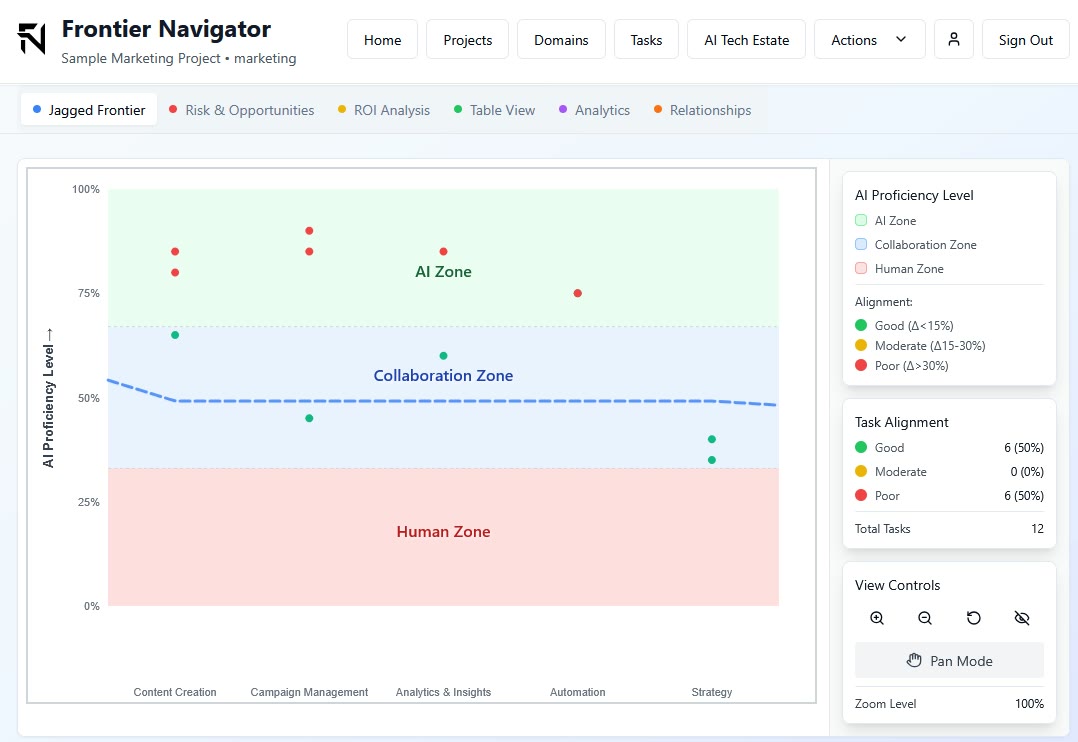
Whether it's Frontier Navigator or something else entirely, one thing's clear: we desperately need tools designed for this reality. Old school project management software wasn't designed for a world where capabilities change weekly, and the same AI that writes poetry can't count to ten.
Your First PILOT Mission
Pick your most annoying workflow. The one that makes everyone groan in meetings. Test AI on each step - just 30 minutes, I promise.
You'll find at least one task where AI saves 80% of time. You'll also find one where it wastes 200% of time. Congratulations, you've found your frontier.
Write it down. Share it with your team (they'll have stories too). You just finished your first Probe phase.
The Multi-Agent Future is Coming
Soon it won't just be humans working with AI. It'll be AIs working with other AIs. The Model Context Protocol (MCP) and Agent-to-Agent (A2A) protocols are making it possible for AI agents to coordinate complex work.
Organizations using PILOT will be ready to:
- Probe these protocols to see what they can really do
- Integrate multi-agent teams where it makes sense
- Learn from the inevitable unexpected failures
- Optimize agent interactions
- Transform operations to leverage agent ecosystems
Your 2025 Reality Check
Microsoft says "Frontier Firms are already taking shape, and within the next 2–5 years we expect that every organization will be on their journey to becoming one."
Here's how PILOT helps you get there:
Phase 1 (Right Now): Start mapping your frontier. Even without specialized tools, you can begin documenting where AI helps and where it hurts.
Phase 2 (Next Year or Two): Build learning loops that keep up with the shifting frontier. What worked last month might not work next month.
Phase 3 (3-5 Years Out): Become a true Frontier Firm where riding the jagged edge is just how you operate.
The Brutal Truth
McKinsey says leaders have "more permission space than they realize" to deploy AI quickly. But permission was never the issue. Navigation is.
The companies winning aren't the ones with the most AI tools. They're the ones who learned to surf the chaos. They know when to trust the machine and when to trust their gut. PILOT gives you a systematic way to develop that instinct.
McKinsey's researchers think "responsible development" could create a "renaissance" in knowledge work. Maybe. But the window to shape this is closing fast.
Your Move
The Jagged Frontier isn't going away. It's not a bug - it's THE feature. The question isn't whether AI will change your organization. It's whether you'll master the unpredictability or get buried by it.
That gap between what AI promises and what it delivers? It's real, it's growing, and your competitors are already mapping it. Every week you wait is a week they're turning AI's chaos into competitive advantage.
With PILOT, you've got a proper approach to this madness. Here's how to start:
- Probe: Map your frontier this week (seriously, Frontier Navigator makes it pretty painless)
- Integrate: Design your first Centaur and Cyborg workflows
- Learn: Set up a monthly "frontier check" to capture what you're learning
- Optimize: Fix one workflow based on what you discovered
- Transform: Make frontier navigation part of how you think
The companies that'll thrive aren't waiting for AI to get "good enough." They're learning to ride the waves, turning AI's split personality into home field advantage.
Welcome to work in 2025. Mind the gap—it's deeper than you think and moves when you're not looking.