The Algorithm and the Cowpath
On the ecology of sustainable AI systems.
The sheer generative capacity of these large models is intoxicating. You type a few sentences into the context window, the attention heads spin, and out pops a working React component, a poem about entropy, or a passable imitation of a contract lawyer.
Standing on this frontier, it is tempting to believe we can simply pave over the messy, rigid reality of traditional software engineering with this new magic topsoil. Why write brittle, deterministic code when you can just whisper intentions to a supercomputer?
But if you have spent any time trying to actually ship a product built on vibes and probabilities, trying to drag this alchemy out of the demo stage and into the cold light of production, you know that the wilderness fights back. I learned this the hard way when I realized I was asking a poet to do math.
Good AI projects are not monologues delivered by a GPU cluster. They are ecologies that require a careful, almost agricultural understanding of three distinct substrates: what must be handled by the generative magic of the machine, what demands the cold rigor of deterministic code, and where the human hand must touch the soil.
The Three Strands
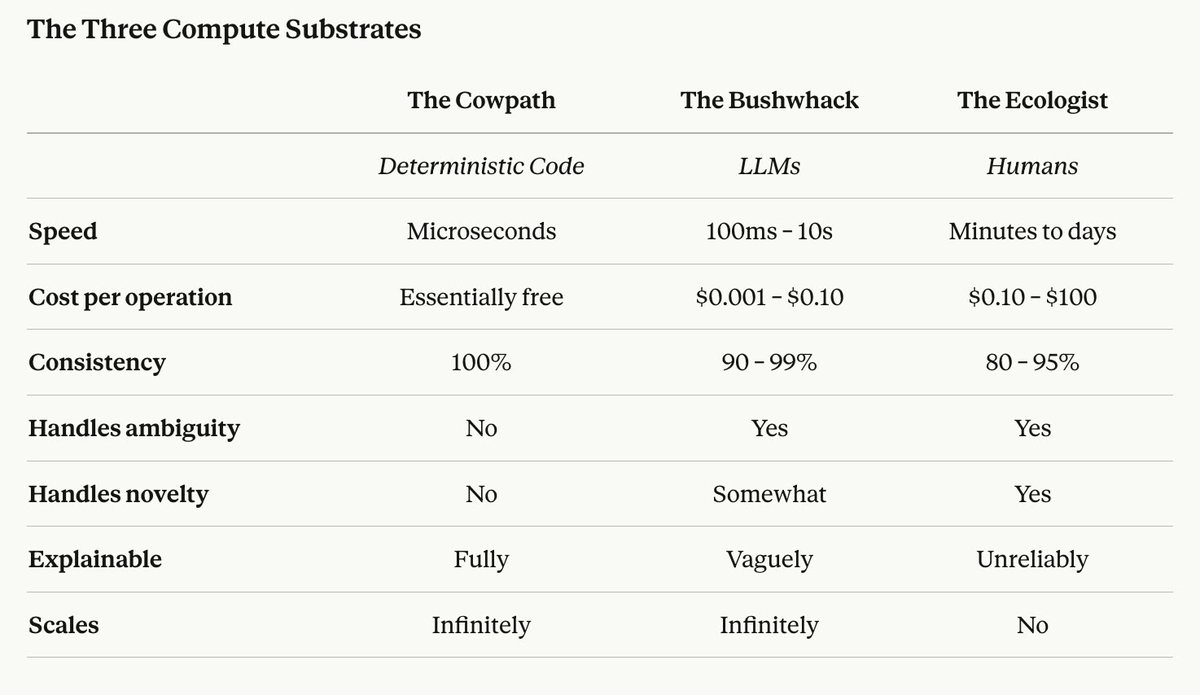
To build a system that survives, we must first admit that we are working with three fundamentally different "physics" of computation. I call them the Three Strands, though you might think of them as species with radically different metabolisms.
The Cowpath (Deterministic Code)
Think of standard code, your if-then statements, your SQL queries, and Zapier workflows as a cowpath.
The first time a path is made, some creature has to push through the resistance of the tall grass. It is slow going. But by the thousandth pass, the earth is packed hard. It is free of roots and stones. You know exactly where it starts, exactly where it ends, and exactly how long it takes to traverse to the microsecond.
It is boring and durable. When you need to move a transaction to a database or calculate a tax rate, you do not want a conversation. You want the cowpath with zero surprises.
The Bushwhack (The LLM)
The Large Language Model, by contrast, does not care about the path. It looks at the dense, tangled forest surrounding the field, the high-dimensional manifold of all human language, and says, "I bet I can get to the other side faster if I just cut straight through that bramble patch."
The LLM is an expedition guide equipped with a machete and a compass. It is fundamentally a probabilistic engine, next-token prediction all the way down. Sometimes, this is breathtaking. The model finds a shortcut through the semantic underbrush that we mere humans never imagined by forging a brilliant, creative trail.
Other times, it wanders into a ravine, gets stuck in a thorn bush, or confidently hallucinates a bridge over a chasm that doesn't exist. This is the "jagged frontier" of AI. The stochastic nature of these models, the very thing that makes them creative, makes them terrible at being consistent.
The Ecologist (The Human)
And then there is us. We are slow (minutes to days of latency). We are expensive and drift. But we possess the one thing the machine lacks: the sense of consequence.
A senior engineer stares at a deployment plan generated by an agent. The plan is clean, logical, and well-structured. But something about it bothers her. She can't articulate it yet. It's a feeling in the gut, a pattern-match against fifteen years of watching systems fail in ways that looked fine on paper. She flags it, and two days later, the team finds an edge case that would have taken down the pipeline.
No model has that instinct…or scar tissue.
We are the keystone in the arch, the only component capable of feeling the difference between a hallucination and a lie. Our task is one of judgment and taste. Not speed. Not scale. The thing that does not compute.
The Inverted Bitter Lesson
There is a famous paper in machine learning called "The Bitter Lesson." Its argument is humbling: researchers who spend years hand-crafting clever features and domain-specific rules keep losing to dumber, more general models that simply absorb more data and throw more compute at the problem. Stop being clever, Sutton says-let the machine learn.
It is a powerful insight. It is also, for the work of building systems with LLMs, almost exactly backwards.
The teams I see failing are not the ones hand-engineering too much. They are the ones hand-engineering too little. They are intoxicated by the model's generality. It can write code! It can do math! It can reason about policy! They let it wander into territory where a five-line Python function would be faster, cheaper, and correct every single time. They are sending the bushwhacker to walk the cowpath.
The bitter lesson for the age of agents is this: do not ask any part of your system to do work it was not built for. The LLM is not built for arithmetic. The database is not built for empathy. Humans are not built to process 10,000 tickets an hour. Each substrate has a physics. Respect it, or the physics will make the lesson bitter for you.
Paving the Desire Paths
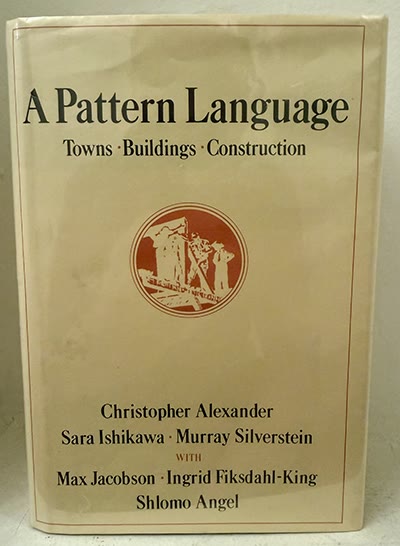
My father was an architect, and when I was young, he pressed a copy of Christopher Alexander's A Pattern Language into my hands. Alexander's core conviction was that the best designs are not imposed from above but discovered from below. Watch where people actually walk across the grass, then pave that. Landscape designers came to call these emergent trails desire paths, and the name stuck.
The most elegant AI architectures emerging today follow this principle exactly.
You start with a messy human request: "Check my email for invoices and put them in the expenses folder." An unguided LLM might try to execute this live, forging a new route through the underbrush every time. A hybrid system works differently. It asks the LLM to write a plan that translates fuzzy intent into a rigid, executable workflow.
Then we pause and switch substrates. A human verifies the plan. Once verified, we freeze it. The bushwhack becomes a cowpath. The desire path gets paved.
This pattern is showing up everywhere. OpenClaw, one of the fastest-growing open-source projects in GitHub history, uses a workflow engine where the LLM helps author the automation, but execution runs deterministically. Anthropic's Skills system follows the same logic. In both cases, the LLM is no longer deciding what comes next. It has been demoted from project manager to specialist consultant, which is exactly where it belongs.
Alexander understood something the AI industry is still learning: the people closest to the problem are the best designers of the solution. The machine's job is to help them find the path. The engineer's job is to pave it.
The Jidoka Guardrail
There is history here that is older than silicon.
Before 1896, industrial looms required constant human attention. If a single thread snapped, the machine would keep churning, producing yards of defective, useless cloth. Sakichi Toyoda, founder of the company that became Toyota, invented a simple mechanism: a lever that fell when a thread broke, instantly halting the machine.
He called this Jidoka: “automation with a human touch.” It evolved into the famous Andon Cord on assembly lines.
In the age of AI, we are the ones holding the Andon Cord. We are the sanity check. And we have seen what happens when systems run without one. Air Canada’s chatbot hallucinated a refund policy that didn’t exist and created a legal obligation the airline was forced to honor. The “One Dollar Chevy” bot, tricked into selling a truck for a buck, had no deterministic guardrail to check the price against MSRP. These were looms running without a thread-break sensor, weaving air.
But Toyoda’s insight was binary: thread intact or thread broken, run or stop. Real AI systems need something more graduated.
Not all threads carry the same load. Authentication logic, data validation, and financial calculations: these should be locked down and human-verified immediately. Anything where a 0.1% error rate is unacceptable gets frozen into a cowpath as fast as possible.
Other threads can stay loose. A prompt template that generates marketing copy? Let it evolve. The cost of a suboptimal generation is low; the value of continuous improvement is high.
Think of it as a spectrum from pure wilderness to pure trail. Creative tasks live on the wild end. Validation and security live on the paved end. Workflows and orchestration occupy the middle ground, structured enough to be reliable, flexible enough to improve.
The mistake is applying the same tension everywhere. Freeze too early, and you lose the adaptive capacity that makes AI valuable. Freeze too late, and you’re running a casino where every customer interaction is a new roll of the dice. The art is in reading which thread you’re holding and pulling it exactly tight enough.
This principle scales all the way down to the personal. If you’ve ever caught yourself typing the same prompt into ChatGPT for the third time, you’ve already discovered a desire path. Pave it. Save it as a skill, a GPT, a Gem. Even at the level of a single user and a chatbot, the pattern holds: find what works, then freeze it so you can move on to the next stretch of wilderness.
The Age of the Centaur
We are entering what chess players call the Age of the Centaur.
After Garry Kasparov lost to Deep Blue, he didn't quit. He created tournaments where human-computer teams competed against one another. The result was fascinating. The winner wasn't the strongest computer, nor the strongest human grandmaster. It was the team with the best process. A pair of amateurs with average PCs could beat a grandmaster with a supercomputer if they knew exactly when to trust the machine's tactical calculation and when to override it with human strategic judgment.
This is the central thesis of sustainable AI:
Weak Human + Machine + Better Process > Strong Human + Machine + Inferior Process
The architectures that survive will be those that respect the distinction between the cowpath and the bramble patch. But survival is table stakes. The interesting question is what comes next.
I think it will be a new kind of literacy. Not prompt engineering, which is already becoming a quaint artifact of the transition period. It will be something deeper-a widespread, intuitive understanding of which substrate to reach for in a given moment, the way a good cook knows without thinking whether a problem calls for heat, acid, or time.
We are not going to get there by clinging to the old ways or simply building bigger models. We’ll get there by watching where the paths form, and paving the ones that hold.